CHAPTER 3 : WHAT THE WALL WAS HIDING

The bucket struck the upper bricks.
A section of the warehouse wall folded inward with a deafening crash.
Dust rolled across the loading dock.
Workers scattered.
Victoria covered her mouth and ran toward the gate.
Then the excavator stopped.
The operator had seen the court order.
He climbed down and refused to continue.
“I was told the building had been cleared by the state,” he said. “Nobody said anything about an investigation.”
Evelyn walked toward him.
“You were hired to complete a job.”
“I was hired to remove an unsafe structure,” he replied. “Not destroy evidence.”
The state investigators entered through the broken wall.
Behind the fallen bricks, they discovered a second interior barrier that did not appear on any building plan.
A narrow passage ran between the two walls.
Inside it were dozens of sealed industrial drums, old employee health records, and water-damaged cardboard boxes stamped with the Vance Holdings logo.
Daniel had been right.
The warehouse had not been empty.
It had been used as a vault.
A hazardous-materials team arrived before sunrise.
The first tests detected chemical residue in several drums.
Further examination revealed that Vance Textile had received internal warnings about employee exposure more than twenty years earlier.
Instead of reporting the problem, executives had moved the containers behind the false wall and paid officials to approve incomplete inspections.
The blue ledger was found inside a locked fireproof cabinet.
The original—not the altered copy planted to implicate Arthur.
Arthur’s name did not appear anywhere in it.
Evelyn’s did.
Beside several payments were handwritten initials matching those on documents she had signed for decades.
One entry referred to Daniel.
D. HARRINGTON — AUDIT TERMINATION.
Another referred to Victoria.
V. HARRINGTON — REMOVE FROM PROJECT.
The final entry had been added two weeks before the gala.
PRESSURE THROUGH CHILD.
Victoria stared at the words.
Evelyn had planned the confrontation.
Perhaps not every movement.
Perhaps not Lily’s scream.
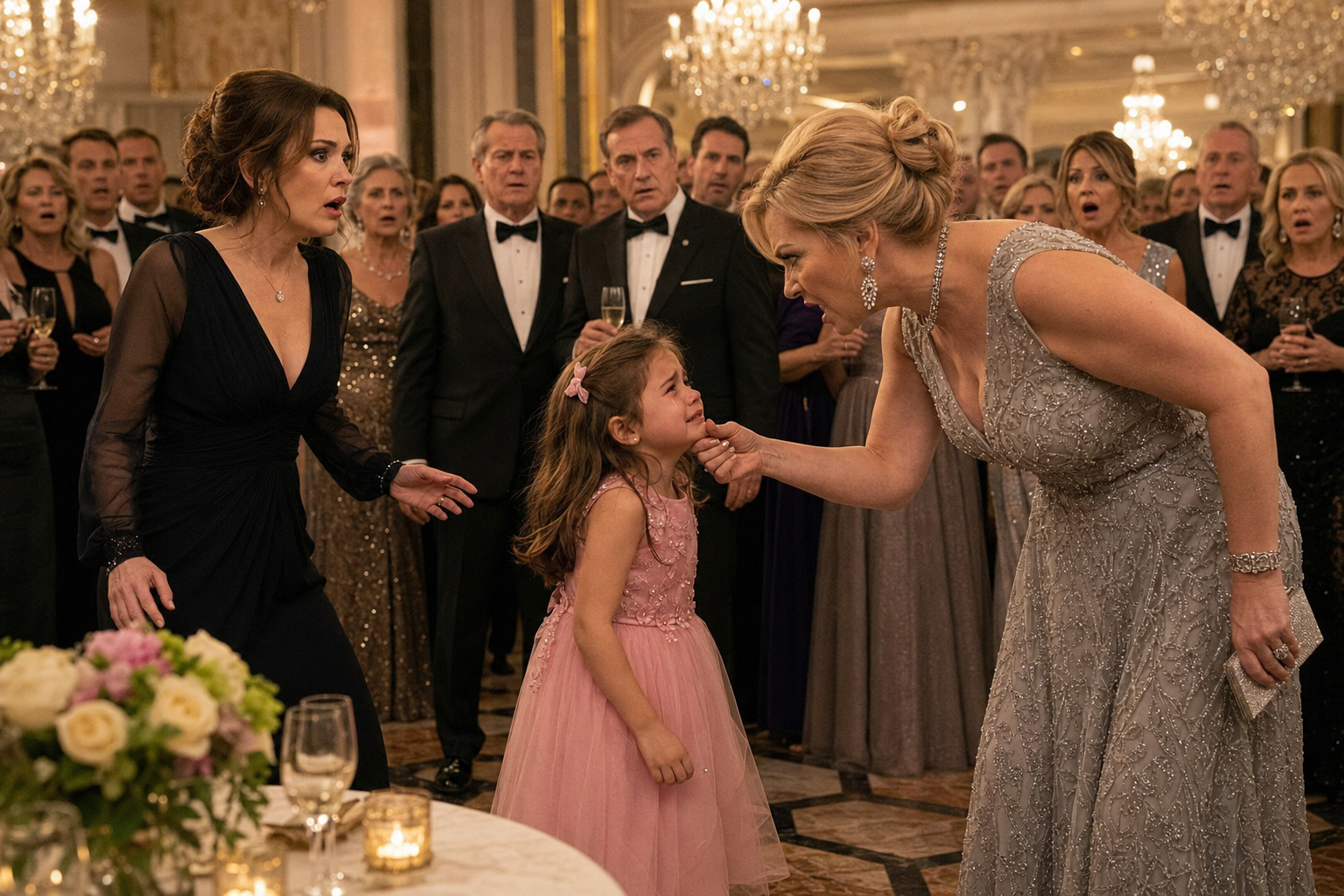
But she had entered that ballroom intending to use a six-year-old girl to frighten her mother away from Harbor House.
The state investigator photographed the page.
Evelyn watched from outside the fence as officers approached.
Her expression remained composed until they asked her to turn around.
“You cannot possibly believe a handwritten book proves anything,” she said.
“It proves enough for a warrant,” the lead investigator replied.
“My attorneys will have this dismissed before lunch.”
“Then they’ll be busy.”
The officers escorted her toward an unmarked vehicle.
For the first time, no donor stepped forward.
No politician made a phone call.
No board member offered a statement of support.
Evelyn had spent decades building relationships based on fear.
Fear disappeared quickly when it became inconvenient.
Before entering the vehicle, she turned toward Victoria.
“You think you won?”
Victoria stood behind the fence with dust on her silver-gray coat.
“No.”
Evelyn seemed almost surprised.
“This was never about winning,” Victoria continued. “It was about stopping you.”
Evelyn’s expression hardened.
“People will forget this.”
“Lily won’t.”
The vehicle door closed.
The investigation lasted eleven months.
Three former city officials pleaded guilty to accepting payments connected to the warehouse inspections.
Northstar Civic Strategies was exposed as a shell company used to route money through fake consulting agreements.
The man arrested outside Victoria’s house admitted that a Vance Holdings executive had hired him to retrieve Daniel’s key.
The executive agreed to testify.
Evelyn was charged with bribery, obstruction, evidence tampering, and conspiracy.
Her attorneys delayed every hearing they could.
But they could not delay the footage.
They could not erase Daniel’s files.
And they could not explain the words PRESSURE THROUGH CHILD written inside the original ledger.
Victoria was not charged for striking Evelyn.
The district attorney acknowledged that the video showed Victoria reacting after repeated physical interference with her child.
Victoria did not celebrate the decision.
She still told Lily the truth.
“Protecting someone doesn’t mean every choice you make will be perfect,” she said. “It means you take responsibility for your choices while making sure the person who caused the harm takes responsibility too.”
Lily considered this carefully.
“Would you do it again?”
Victoria smiled faintly.
“I would step between you sooner.”
That answer seemed to satisfy her.
Arthur resigned from the Pendleton Family Foundation six months later.
Not because he had done anything wrong.
Because he believed Harbor House should be led by someone whose future mattered more than his reputation.
The board elected Victoria as chair.
She accepted on one condition.
The center would never have a ballroom named after a donor.
Its rooms would be named for the children and therapists who used them.
The contaminated drums were safely removed.
The false wall came down.
Much of the old warehouse had to be demolished, but the original brick entrance was preserved.
Construction began the following spring.
On opening day, hundreds of families gathered outside the new Harbor House Children’s Center.
There were no champagne towers.
No velvet ropes.
No seating chart designed to measure anyone’s importance.
Children ran through the entrance carrying backpacks, stuffed animals, and therapy folders.
Lily wore a blue dress.
She had refused to wear pink for almost a year.
Victoria never pressured her.
At the front of the building stood a small bronze plaque.
It did not mention Evelyn.
It did not mention the scandal.
It read:
FOR EVERY CHILD WHO WAS EVER TOLD
THEY DID NOT BELONG.
Lily stood beside her mother as reporters gathered near the entrance.
A journalist crouched and asked whether she remembered the night at Whispering Pines.
Lily looked up at Victoria.
Victoria gave her the freedom to answer or walk away.
Lily faced the reporter.
“I remember the mean lady,” she said.
The journalist waited.
“But I remember my mom coming to get me more.”
Victoria looked away before anyone could see the tears in her eyes.
Arthur cut the ribbon.
The doors opened.
Families entered.
Later that afternoon, Victoria and Lily walked through the center after the crowds had gone.
They passed speech-therapy rooms filled with picture cards, sensory equipment, and shelves of brightly colored books.
In the children’s art room, Lily stopped in front of a blank canvas.
“Can I paint something?”
“Of course.”
Lily chose pink.
Victoria watched her cover the canvas with wide, fearless strokes.
A year earlier, the color had represented the dress she wore on the worst night of her life.
Now it belonged to her again.
When she finished, Lily held up the painting.
It showed two figures standing beneath a chandelier.
One was small.
One was tall.
Between them was a silver line stretching across the room.
“What’s the line?” Victoria asked.
Lily smiled.
“That’s you coming to get me.”
Victoria knelt beside her.
“I will always come.”
Lily leaned against her mother’s shoulder.
Outside, sunlight moved across the preserved bricks of the old warehouse.
Evelyn Vance had believed power belonged to the person who controlled the room.
She had been wrong.
May you like



Real power belonged to the person willing to cross it.
And Victoria had crossed the distance between them.