CHAPTER 2: WHAT THE CAMERAS REMEMBERED
The first recording was dated eleven months earlier.
Peter did not watch it.
Detective Ellis advised him not to.
She said the investigators needed to review the material without family members being exposed to images they could never erase from their minds.
But she told him enough.
The cameras had not been installed for security.
They had been installed for control.
Reena watched the children from her phone while she was away.
She sent messages to Clay whenever Drew tried to open the basement door or reach the kitchen without permission.
She kept handwritten records of meals.
Not meals served.
Meals denied.
Tuesday: Drew talked back. No dinner.
Wednesday: Lily cried after lights out. No breakfast.
Friday: Both downstairs until apology.
The messages between Reena and Clay were worse.
They treated the children’s fear like an inconvenience.
Sometimes like entertainment.
Clay had written that Drew needed to “learn who was in charge.”
Reena had replied that Lily would do anything if she thought Drew might be punished.
Peter sat in Detective Ellis’s office while she summarized the evidence.
He stared at the wall behind her desk because looking directly at her made everything feel too real.
“Why?” he finally asked. “Why would she do this?”
Detective Ellis closed the file.
“There may never be an answer that feels sufficient.”
“Was it money?”
“Partly.”
Reena had been receiving Aaron’s life insurance payments and survivor benefits intended for the children.
Most of the money was gone.
Some had been spent on vacations.
Some on jewelry.
A large amount had been transferred to Clay.
The children had been dressed in secondhand clothes, given limited food, and kept out of school under the claim that Reena was homeschooling them.
“She didn’t want anyone seeing them,” Peter said.
“That’s what we believe.”
Peter looked through the office window.
Drew and Lily had been moved to a protected pediatric unit.
A social worker remained nearby at all times.
Lily had begun speaking more, but only when Drew was present.
Drew still watched every door.
Even when nurses entered with food.
Especially when nurses entered with food.
“Did the cameras show how he injured his leg?” Peter asked.
Detective Ellis paused.
“Yes.”
Peter waited.
She chose her words carefully.
“Drew tried to reach a cabinet where Reena kept crackers. He climbed onto a chair. Clay entered the kitchen and frightened him. Drew fell.”
“And they left him like that.”
“They carried him downstairs.”
Peter’s eyes closed.
“For two weeks.”
“Yes.”
A sound escaped him.
Not quite a sob.
Not quite a word.
He lowered his head into his hands.
Detective Ellis waited until he could breathe again.
“There’s something else,” she said.
Peter looked up.
“One of the basement cameras recorded the escape.”
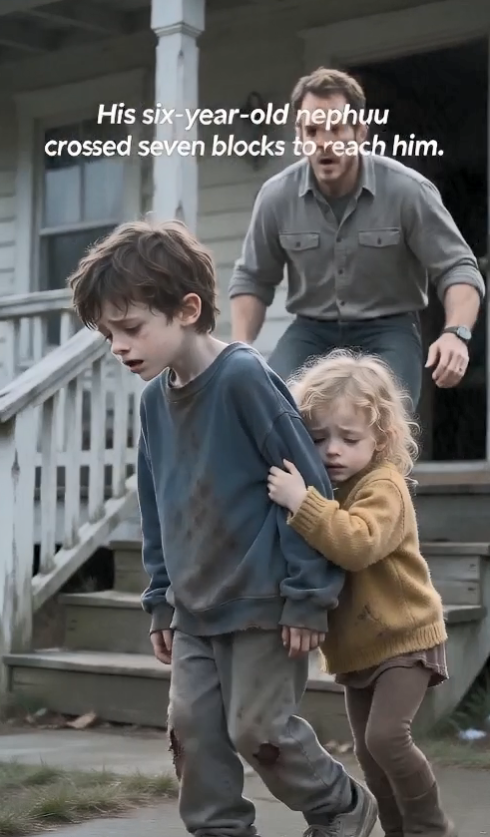
Drew had spent six nights working on the window.
He hid a screwdriver beneath the mattress.
Each time Reena left the house, he loosened one screw.
Then another.
Then another.
He used a piece of cardboard to cover the marks whenever he heard footsteps on the stairs.
On the seventh morning, Reena left with Clay.
Drew pulled the frame loose.
He pushed Lily through the opening first.
Then he dragged himself after her.
He used a broken broom handle as a crutch until it snapped two blocks away.
After that, he crawled.
Peter turned toward the observation window.
Drew sat in a wheelchair beside Lily’s bed.
He was helping her color a picture of a yellow house.
Seven blocks.
A six-year-old had measured the distance between fear and safety one movement at a time.
“How did he know where I lived?” Peter asked.
Detective Ellis opened another evidence bag.
Inside was a folded sheet of paper.
The edges were soft from being handled so often.
It was a hand-drawn map.
The lines were uneven.
Several street names had been copied in a child’s handwriting.
At the end of the route was a square marked with one word.
PETER.
“He remembered your porch,” Detective Ellis said. “But he wasn’t sure how to get there. He studied the neighborhood whenever Reena drove past.”
Peter looked closer.
Beside the square, Drew had drawn two stick figures.
One tall.
One small.
They were holding hands.
“Can I keep this?”
“After the case.”
Peter nodded.
A knock sounded at the door.
The hospital social worker, Grace Miller, entered carrying a folder.
She was young, serious, and kind without being falsely cheerful.
“We have an emergency custody hearing tomorrow morning,” she said.
Peter stood.
“Custody?”
“Child Protective Services is asking the court to place Drew and Lily with a relative while the criminal case proceeds.”
“With me.”
Grace met his eyes.
“That is one possibility.”
“One possibility?”
“You have a stable home. No criminal history. You’re employed. The children know you.”
“Then what’s the problem?”
“Reena’s attorney is arguing that you have not maintained a relationship with them.”
Peter laughed once, bitterly.
“She stopped me.”
“I know.”
“She returned my letters.”
“I know.”
“She lied every time I came to the house.”
“We’re gathering proof.”
Peter looked through the window again.
Drew had fallen asleep in his wheelchair with his head against Lily’s mattress.
“I’m not letting them go to strangers.”
Grace softened.
“The court will focus on what is safest for the children.”
“I am what’s safest.”
“That may be true. But tomorrow, you have to prove it.”
Later that evening, Peter sat beside Drew’s bed.
Lily slept with one hand wrapped around the sleeve of his shirt.
Drew watched the television without really seeing it.
“A lady said we might go somewhere else,” he said.
Peter had promised never to lie to him.
So he didn’t.
“There’s a judge who has to decide where you and Lily stay while everything gets sorted out.”
Drew’s face tightened.
“Not with Reena?”
“Never with Reena.”
“Together?”
Peter leaned closer.
“I will fight with everything I have to keep you together.”
Drew looked down.
“That’s not the same as yes.”
Peter felt the truth of that sentence.
“No,” he admitted. “It isn’t.”
Drew was silent for a long time.
Then he reached beneath his pillow and pulled out a small plastic bracelet Lily had made in the hospital playroom.
Yellow beads.
Blue beads.
One red bead in the middle.
He held it out.
“For tomorrow.”
Peter accepted it.
“What does it do?”
“It makes you remember.”
“Remember what?”
Drew looked directly at him.
“That we picked you.”
Peter closed his hand around the bracelet.
The next morning, he walked into the courthouse wearing it around his wrist.
Across the room, Reena sat beside her attorney in a county-issued uniform.
When she saw the bracelet, her expression changed.
And Peter understood something immediately.
May you like


She recognized it.
She knew exactly what it meant.